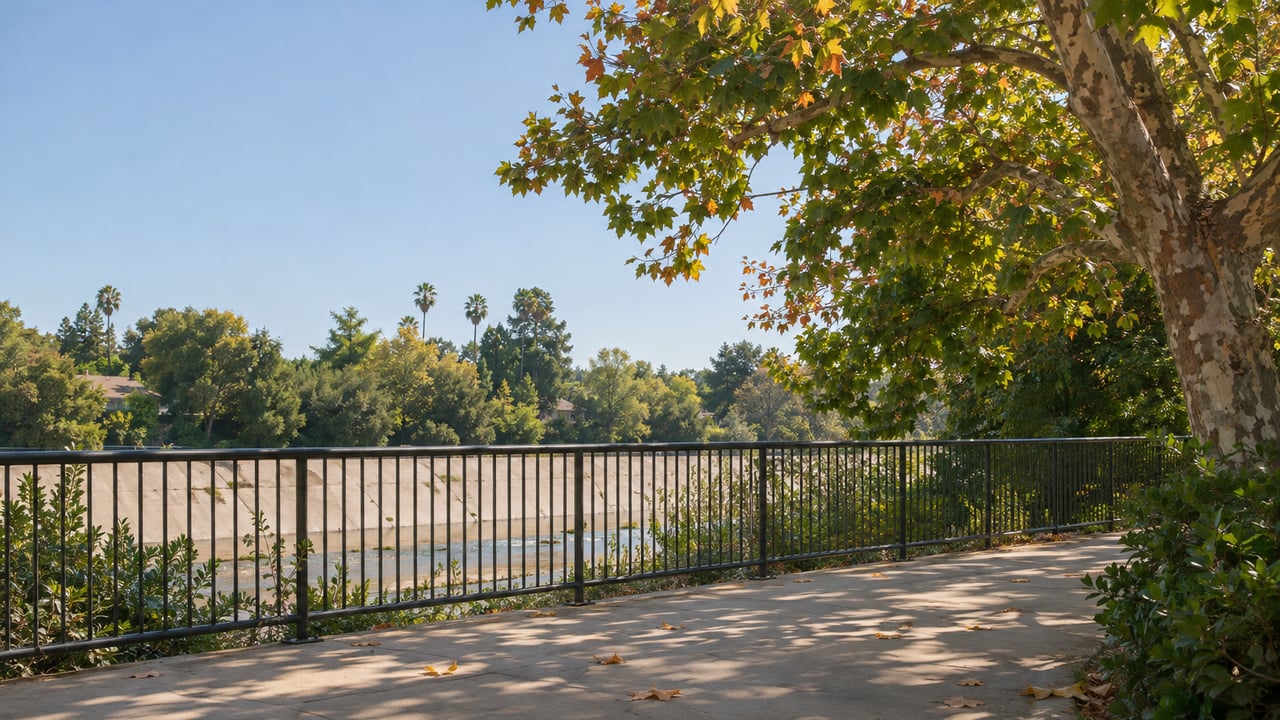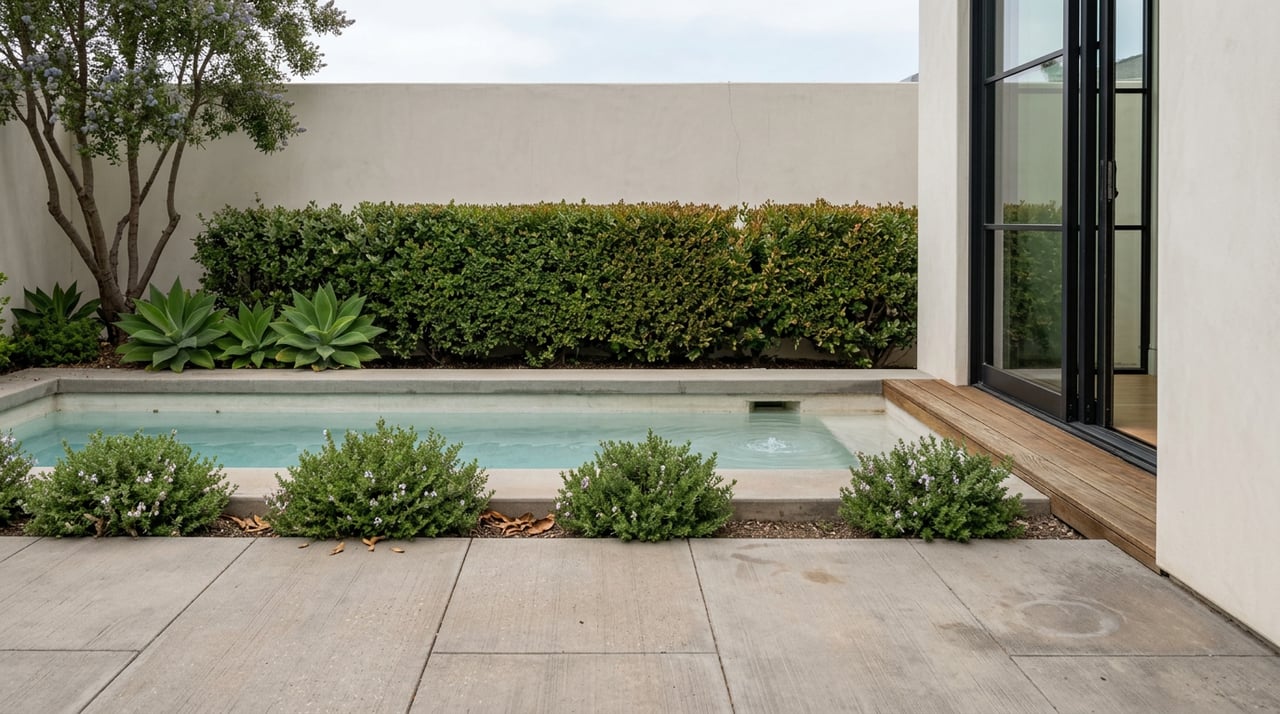
"We're looking for 200 homes where these seedlings can be planted to fill in gaps along the canals." The Venice Canals Association posted the request on its site this year, highlighting the neighbor-led work involved in caring for this mile-and-a-half grid of water. The prettiest historic district on the Westside is maintained through a mix of city services and residents' participation.
If you live along Carroll, Linnie, Howland, Sherman, Eastern, or Grand, you already know the canals are not a park. The canals' upkeep includes city-contracted landscaping and tasks residents take on themselves. Salt Bush along the water's edge forms a living safety barrier, while residents are pursuing a grant application to study runoff and water quality. The canals' appeal goes hand in hand with less visible work to maintain them.
The Salt Bush Barrier and Resident Stewardship
When the Venice Canals were rebuilt between 1991 and 1993, after decades of condemned sidewalks and filled-in waterways, residents and the city settled on a living safety barrier instead of a fence or a railing. They planted Brewer's Salt Bush, or Atriplex, along the water's edge, a low, salt-tolerant shrub that softened the drop into the canal without blocking the view anyone paid a premium to have.
That planting is now about 33 years old. Salt Bush typically lives closer to a decade. The math has caught up with the canals, and the Venice Canals Association is now working with Mariposa Landscaping to close the gaps, seedling by seedling, at no cost to the homeowner whose frontage needs one. The catch is that the city's maintenance contract with Mariposa covers trimming, weeding, and debris removal, not watering. A new seedling has to be hand-watered twice a week through the hottest months just to root, which means the barrier's survival depends on whoever lives behind it actually showing up with a hose. Some of the new plantings, the association notes, have already been stolen before they had the chance to take.
This is a small maintenance task in a neighborhood that photographs like a movie set. It also shows how resident participation contributes to the canals' upkeep: a resident can sign up to help care for the barrier.
Nine Bridges, No Lifeguard
The physical layout rewards knowing it rather than just admiring it. Six canals make up the district: Carroll, Linnie, Howland, and Sherman run east to west, while Eastern and Grand run north to south, laid out in a grid roughly a mile and a half long and fifty feet wide, five feet deep at center. Nine pedestrian footbridges cross the water within the district, and Dell Avenue, the single one-way vehicle entrance off Sherman Canal, crosses four more on its way north.
| Canal | Orientation |
|---|---|
| Carroll | East-West |
| Linnie | East-West |
| Howland | East-West |
| Sherman | East-West |
| Eastern | North-South |
| Grand | North-South |
The Venice Canals Association's own count of how many homes sit inside that grid varies from one page of its site to the next, somewhere between roughly 200 and 350 families depending on which document you read. The association's pages give different counts, reflecting the range of estimates available for this district. The canals made the National Register of Historic Places in 1982 and were declared a Los Angeles Historic-Cultural Monument the following year, while the association's day-to-day records rely on volunteer time.
A Grant Application to Study Canal Water
The canals draw their water from Marina del Rey through tidal gates, and that water is not immune to the algae problems showing up elsewhere in Southern California. After a stretch of dogs falling ill near the canals, with no definitive link established to toxic blooms, Los Angeles County's health department said it would repost hazardous algae bloom signage along the walkway, out of what the association describes as an abundance of caution. Not every bloom is harmful, and some algae growth actually benefits the fish and birds that live there, but telling the difference in real time is hard, and it is getting harder as conditions shift with the climate.
The association is pursuing a Prop W grant application in partnership with Los Angeles City Sanitation to study whether runoff feeding into Ballona Lagoon and the north canals could be captured, cleaned, and stored for future use. This is a study proposal, not a completed solution. For now, the association is working on a potential longer-term approach to water quality.
Who Actually Uses the Canals When the Tourists Go Home
The same water quality that residents are working to protect is what makes the canals function as a de facto bird sanctuary in the middle of a dense residential grid. Species regularly spotted along the six canals include herons, egrets, mergansers, coots, cormorants, gulls, pelicans, and occasionally the Least Tern, alongside the resident population of domesticated mallards that most visitors assume are wild. None of them wait for an audience. They show up on the water whether anyone with a camera is standing on the footbridge or not.
That ecosystem is part of what the salt bush barrier and the algae monitoring are actually protecting. It is easy to treat the wildlife as scenery. It is closer to the truth to say the wildlife is a running audit of whether the shared maintenance efforts are working.
A Calendar of Neighbor-Organized Events
The events calendar offers another view of community life along the canals. This July 4th, the association hosted its annual rubber duck race and fundraiser at Sherman and Grand Canal, with duck pre-sales held earlier that month at Dell Avenue and Linnie Canal. Throughout the year, residents organize Music on the Canals, an informal gathering built around neighbors sharing music with each other rather than a booked act. Canal bridges get decorated by the people who live near them for the winter holidays and again for Valentine's Day, and this fall brings Canaloween, a costume party centered on the park that leans toward families and kids rather than a bar crawl.
The Venice Canals Association organizes these events and also works on the Salt Bush planting effort and the Prop W grant application. The duck race funds the group's work. The bridge decorating is just neighbors deciding the holidays should look a certain way on their own street. If you have written off the canals as a place tourists photograph and residents merely tolerate, the calendar says otherwise.
What This Actually Means If You Live Here
The Venice Canals' upkeep includes neighbors' contributions: watering a seedling twice a week, pursuing a grant application, and decorating bridges. That is a different kind of neighborhood stability than a homeowners association with a maintenance fee and a landscaping contract. It works, and has worked for over three decades since the 1991-93 renovation, but it works because people keep opting in.
If you already call this grid of water home, the invitation from the association is worth taking seriously the next time it comes through, whether that means a seedling in front of your own house or ten dollars for a rubber duck in July. For anyone weighing what a canal-front property is actually worth in this market, or thinking about how a home's condition and story affect its position with buyers, our team at Alphonso | Bjorn spends real time in Venice and the surrounding Westside markets, including a closer look at how architecture shapes value along the canals and Abbot Kinney corridor. If you'd like a clear-eyed read on where your property stands today, schedule a Free Home Repositioning Strategy session and we'll walk through it together.